
What the STOP THE BLEED® Brand Stands For
What the red octagon and the raised hand actually promise.
In short: STOP THE BLEED® is an official program of the U.S. Department of War. The name and logo identify training and equipment held to a standard the department built over two decades of combat casualty care, and only licensed instructors, organizations, and companies may use them. That is the promise behind the brand whenever you see it.
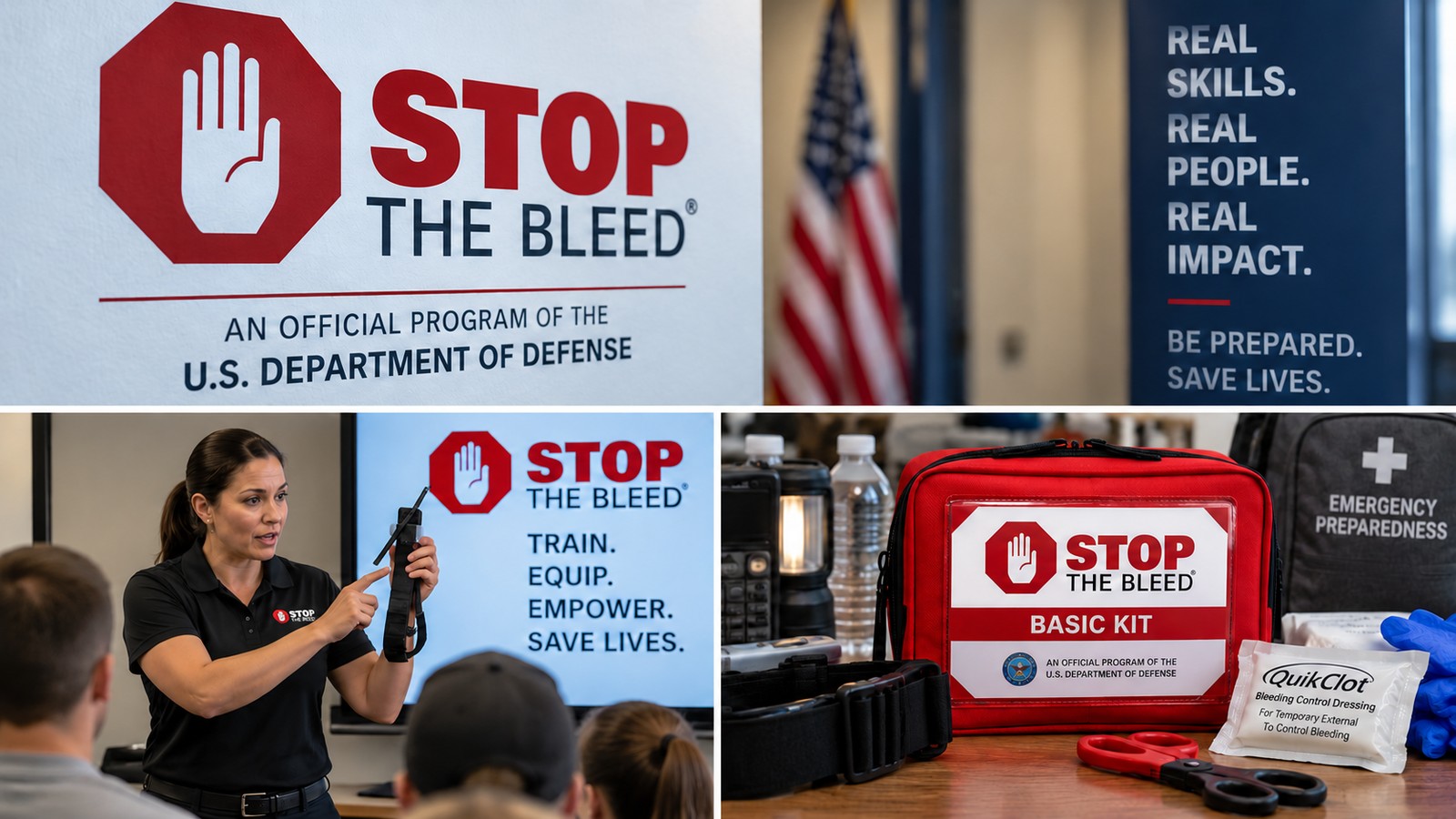
Most people first run into STOP THE BLEED® on a poster, on a kit mounted by an exit, or in a two-hour class at work. The red octagon and the raised hand are hard to miss. What is easy to miss is that the brand is neither a slogan nor a product name. The name and logo are registered to the Department of War (in legal terms, a trademark), which means no one may use them without the department’s permission. They appear on that poster, that kit, and that class because someone was licensed to put them there. Here is what that means for you.
Where the program came from
During the wars in Iraq and Afghanistan, the Department of War learned that many combat deaths from bleeding could be prevented if the person closest to the wounded knew what to do and had the right equipment. Soldiers with no medical training, taught a few techniques and issued a tourniquet, saved the lives of the people next to them. The department studied what worked, refined it, and made it standard practice.
STOP THE BLEED® brings that standard to civilians. The program launched nationally in 2015. The Department of War owns the brand and stands behind the training and equipment that carry it, and everything the program teaches or accepts into a kit traces back to that evidence.
Many names, one standard
Walk through the market and you will see the same skills and the same kinds of kits sold under a dozen names. Bleeding control. Bleed control. Hemorrhage control. Traumatic bleeding. Trauma kit. Stop-the-bleeding kit. Some are classes, some are products, and most of the names are ordinary English that anyone can use. That is confusing on its own. The bigger problem is that a generic name tells you nothing about the standard behind it. Two kits called “bleeding control kit” can have completely different contents, and two classes with the same name can teach in completely different ways.
STOP THE BLEED® is different because it is a standard, not a description. The name belongs to the program, and it can only appear on training and equipment that meet the program’s requirements. A product called “Bleeding Control Kit” tells you what it is for. A kit carrying the STOP THE BLEED® name and logo tells you what it was built to, who was allowed to build it, and what has to be inside. The program spells out those requirements on its Standards page.
Four promises, each one checkable
When the STOP THE BLEED® name is on something, it means four things, and you can verify every one of them.
The training is the program’s training. A STOP THE BLEED® class is taught by a licensed instructor using an approved curriculum. It covers three techniques (direct pressure, wound packing, and tourniquet application) and teaches them the way the evidence says they work.
The equipment has been reviewed. Every tourniquet and hemostatic dressing sold under the brand has been reviewed and accepted by the program, which works from the recommended-device list kept by the Department of Defense Committee on Tactical Combat Casualty Care. Each one is a medical device regulated by the U.S. Food and Drug Administration.
The kit is a defined thing. There are three STOP THE BLEED® kits (Basic, Intermediate, and Advanced), and the program decides what goes in each. A licensee cannot leave out a required item, swap in a device the program has not accepted, or invent a fourth kit.
The seller is licensed. Only companies that hold a license from the Department of War may sell STOP THE BLEED® equipment, and the list of those companies is public.
Who may use the brand, and who may not
Licensees, in three groups. Instructors and training organizations hold educational licenses. Companies that make or sell kits hold product licenses. Sponsors and partners that promote the program hold promotional licenses. Every license comes with brand standards the licensee agrees to follow, and a license that is not followed can be revoked.
Anyone else is free to talk about STOP THE BLEED®, recommend it, or link to it. What they cannot do is put the name or logo on a class, a product, or a website in a way that implies the program stands behind it.
Why the program guards the brand
A brand like this only works if it means one thing. If any seller could put a red octagon on any kit, the octagon would tell you nothing, and the person opening that kit on the worst day of someone’s life would be trusting a logo with no standard behind it. Enforcement is not about protecting a brand for its own sake. It is how the program keeps its promise to the bystander.
What to do with all this
Take the class from a licensed instructor. Buy equipment from a licensed seller, and run the four-second check before you do. The STOP THE BLEED® name comes first, the kit is named Basic, Intermediate, or Advanced, the label says “Assembled by,” and the devices are ones the program has accepted. If you see the name or logo used without a license, tell the program.
The red octagon and the raised hand are a stop sign for bleeding. They are also a signature. The Department of War puts its name on the training and equipment that carry them, and on nothing else.
Where to start
The Standards page explains the brand in more detail, including what licensees agree to. The STOP THE BLEED® Equipment page lists the licensed sellers, the three kits, and the accepted devices, and shows how to spot a lookalike. The Training page will help you find a class near you.
STOP THE BLEED® is a registered trademark of the U.S. Department of Defense.